Evenline™ — Organic Ashwagandha Root + Black Pepper
Why the People Who Can Handle Anything Finally Have a Way to Leave Work at Work
For the consultant who checks emails at the dinner table. The attorney who replays depositions on the drive home. The executive who's physically in the living room but mentally still at their desk. The following seven reasons explain what's actually happening — and what's finally changing.

"I want to be honest because I almost didn't try this. I've already tried the obvious things — a glass of wine after work, melatonin when I couldn't fall asleep, a guided meditation app I opened twice and deleted. None of it worked. The wine would knock me out faster but I'd wake up at 2 AM and lie there until 4. Somewhere around week three I realized I'd cooked an entire dinner without checking my phone once. That sounds like nothing. For me it was everything."
"I tried a popular high-dose ashwagandha extract for about six weeks. The first two weeks I thought it was working. The following four I felt like someone had quietly unplugged my personality. I wasn't stressed, but I wasn't anything. My drive disappeared. Then a friend explained the difference between high-dose extracts and traditional whole root. Eight weeks in on Evenline. The calm is real. But I'm still me."
"My therapist used the phrase 'present but absent' to describe what my kids were experiencing with me. I'm a corporate attorney. By 7 PM, when I'm supposed to be a parent, there's nothing left. Last Sunday I took my kids to the park and I was actually there. My daughter asked if I was in a good mood. I told her I was just home."
Your Workday Doesn't End When the Laptop Closes. Your Nervous System Didn't Get the Memo.
The commute used to change something. The physical distance between office and front door gave the brain a transition window — enough time to let one context end before another began. That buffer is largely gone now.
Whether you're fully remote, hybrid, or simply carry a smartphone that never stops receiving, the modern workday doesn't have a clean edge. Back-to-back video calls compress into the afternoon. The notification arrives during dinner. The unread email sits at the edge of your awareness from 6 PM until you give in at 10.
This isn't a discipline failure. The sympathetic nervous system doesn't know your commute is over. The neurochemicals that sustain your performance through ten hours of high-stakes decision-making don't dissolve the moment you physically leave the building. They linger. Sometimes for hours.
The result is what sleep researchers call chronic hyperarousal — what we've come to call The Workday Carryover Loop™: you can't wind down because the loop never closed. Simultaneously exhausted and unable to genuinely rest. Drained, but still running. Wired, but tired. The mental tabs never fully close. The background processing never stops.
The Sunday Scaries arrive in your chest at 4 PM — even on a quiet weekend. By Sunday night you're already running Monday's calendar. The workday doesn't end when the laptop closes. It just moves to the dinner table. And the people sitting across from you notice, even when they don't say it.

The Glass of Wine Isn't Helping You Decompress. It's Delaying the Bill.

It works, in a temporary and narrow sense. Alcohol is a central nervous system depressant. It lowers inhibition, blunts the subjective sensation of stress, and — for about 90 minutes — can genuinely quiet the mental noise. This is exactly why the wine-after-work ritual became the default transition for an entire generation of professionals.
But the mechanism is where the problem lives.
After that initial sedative window closes, alcohol triggers a rebound stress response. REM sleep — the stage responsible for emotional regulation, memory consolidation, and cognitive recovery — is measurably suppressed by alcohol, even at moderate amounts. You fall asleep faster. You sleep lighter. You wake up having logged the hours but not earned the restoration.
The cognitive edge that your career depends on gets worn down in increments small enough that you don't notice until you're running on a reserve you didn't know was empty.
Melatonin Will Put You to Sleep. It Won't Turn Off the 1 AM Alarm.
Melatonin is a sleep-onset hormone. Your body produces it naturally in response to falling light levels, signaling to the brain that sleep is approaching. For jet lag, for schedule shifts — it does what it says.
What it doesn't do is address why you're lying awake.
The pattern described above — exhausted enough to want sleep, too activated to achieve it — isn't a melatonin deficiency. It's an elevated nervous system state. Melatonin tells the brain to initiate sleep; it doesn't tell the stress response to stand down.
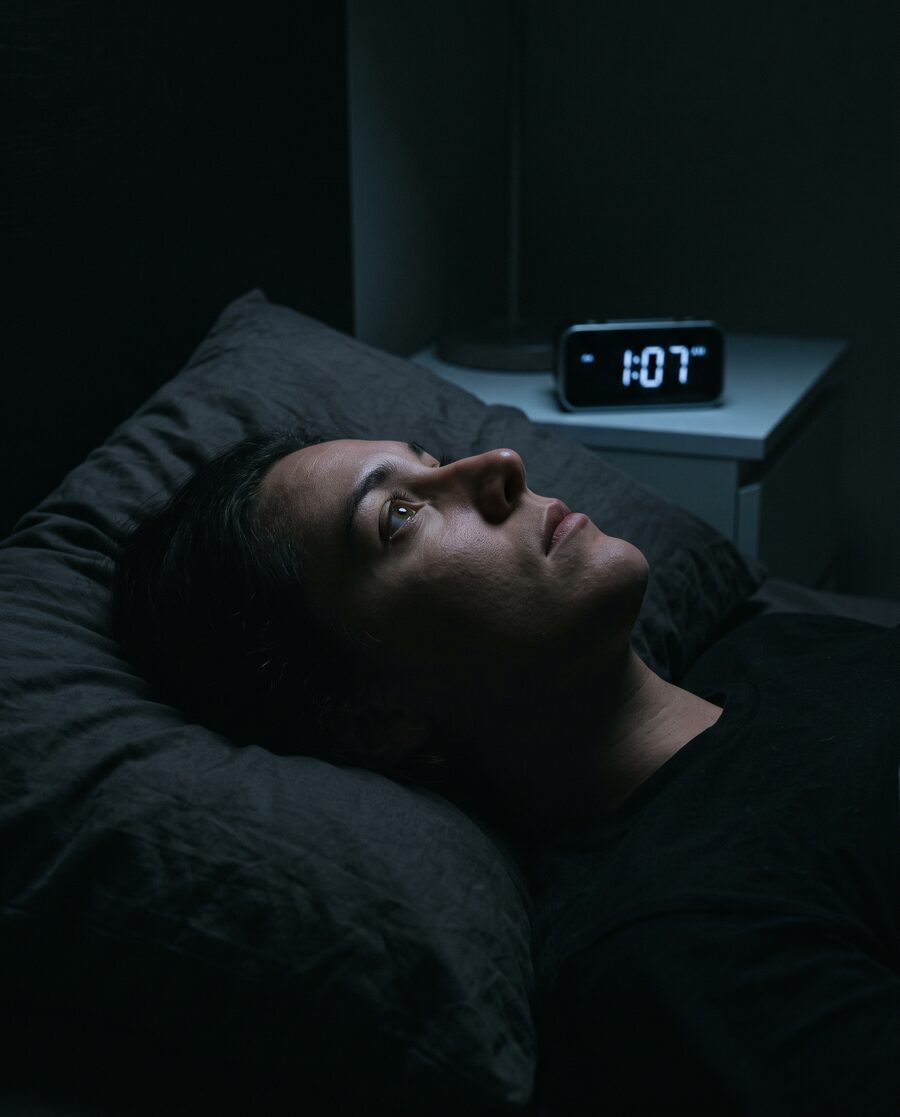
This explains the experience many people recognize immediately: melatonin works, you fall asleep, and somewhere around 1 AM your brain produces what feels like an internal alarm. An intrusive thought about tomorrow. An inexplicable low-grade dread, pulling you out of sleep at an hour when there is nothing to be done about any of it.
There's a companion pattern that comes before the 1 AM wakeup: revenge bedtime procrastination — staying up far later than you intend to, not because you're not tired, but because it's the only part of the day that belongs entirely to you. You've given everything to everyone since 7 AM. The hour after everyone's asleep is yours. The nervous system is still running, so you might as well use it. The cost arrives with the alarm.
That wakeup isn't random. It's the elevated stress state that melatonin temporarily overpowered, reasserting itself once the dose clears. The nervous system was never actually downregulated.
High-Dose Ashwagandha Was Supposed to Fix This. For Some People, It Made Things Worse.

By this point, many high-performing professionals have already tried ashwagandha. The clinical evidence looked genuinely promising — a 60-day randomized controlled trial documenting a 44% reduction in perceived stress scores. The research was real. The category grew accordingly.
What the research didn't capture was what started happening inside a growing and vocal subset of users who stayed on standardized high-potency extracts — concentrated forms like KSM-66 and Sensoril — for extended periods. Online communities began accumulating accounts that followed the same arc. Initial results were positive. Then, somewhere between week four and month three, something else shifted. Drive. Joy. Motivation that didn't return with the morning coffee. The emotional state wasn't depression. It was closer to a dimmer switch moved to a setting with no name — functional, but muted.
"I started feeling like a robot. I couldn't feel anything. Stopped it and took three weeks to feel like myself again."
r/Biohackers — Forum User"KSM-66 gave me brain fog and made me blue, spaced out. I like Organic India more — KSM is very effective but it can kill your motivation."
r/Nootropics — Forum User"I didn't believe the stories about Ashwagandha. Then two weeks ago I suddenly felt increasingly apathetic. I realized it was the ashwagandha."
r/Supplements — Forum UserWhat emerged from these discussions — and what Ayurvedic practitioners had maintained long before supplement brands industrialized the herb — was a consistent pattern. People who moved to traditional whole-root preparations described a different experience. The calm without the flattening. The resilience without the numbness.
Ready to see if Evenline is right for you?
Organic Whole-Root Ashwagandha + Black Pepper · USDA Organic · 60-Day Guarantee
Check Availability & Pricing →60-Day satisfaction guarantee · Free shipping available
Why Ancient Ayurveda Always Paired Ashwagandha with Black Pepper
The name says more than it appears to. Ashwagandha — ashwa (horse) and gandha (smell) — was traditionally understood to confer the vigor and stamina of a stallion. Its botanical species name, Withania somnifera, is Latin for "sleep-inducing." The plant's classical names weren't marketing. They described its dual role: supporting sustained vitality while enabling genuine rest.
What is less known is what traditional Ayurvedic practice always combined ashwagandha with.
Dense botanical roots were rarely administered alone. They were paired with Trikatu — a preparation of black pepper, long pepper, and ginger used to stoke Agni, the digestive fire. The principle was practical: the most carefully sourced root is only as effective as the body's capacity to absorb it. Piperine — the active alkaloid in black pepper — inhibits key liver enzymes and intestinal transport proteins responsible for metabolizing certain compounds before they reach systemic circulation.
Evenline does not claim a specific absorption multiplier for ashwagandha, because peer-reviewed human pharmacokinetic data for that precise claim at these doses does not yet exist. What the formula reflects instead is genuine formulation philosophy: an ancient pairing with a coherent biochemical rationale, included because it belongs there.

No proprietary blend. No undisclosed dosages. No 15-ingredient stack where you can't identify what's actually doing the work. Two ingredients. That is the formula.
Evenline's ashwagandha root is sourced from India and third-party tested for identity, potency, heavy metals, and microbial contaminants before every batch ships. Manufactured in a cGMP-certified facility. Certificate of Analysis available at evenline.com/coa — the full test results, not a summary. This is what verified looks like.
This Isn't a Sedative. It Doesn't Turn Off Your Ambition. It Just Stops the Workday From Following You Home.
The fear arrives predictably at this point. Five reasons in, and the case for daily botanical support has been made — but underneath it runs a concern that serious people have every right to voice:
"What if it takes the edge off?"
This is not an unreasonable concern. Alcohol quiets the noise but compromises recovery. Melatonin forces sleep onset but leaves the underlying activation intact. High-dose extracts blunted the stress response — and for some people, blunted other things along with it.
Ashwagandha as an adaptogen appears to work through a different logic. Rather than overriding the stress response, it supports the body's own capacity to regulate it. The effect, when it arrives, is not the quiet of a system that has been silenced. It is the quiet of a system that has been given space to complete its own downregulation.
Users consistently describe it as: the mental volume turned down, but the channel didn't change. The ambition is still there. The workday is just no longer running in the background after the laptop closes.
The professionals operating at the highest levels for the longest — not just sprinting to burnout — are the ones who protect the recovery as deliberately as they protect the output. Genuine rest is not the absence of performance. It is the condition for the next day's. The Workday Carryover Loop™ doesn't just cost you your evenings. It quietly taxes every morning that follows.

Most people notice nothing dramatic. The compound builds in the system. Some report slightly deeper sleep on heavy days. Both noticing and not noticing are normal.
The shift tends to be situational — a difficult week navigated without the usual residue. Sunday evening carrying a different weight. Often recognized only in retrospect.
Consistent users typically have a clear read by the end of 60 days. Evening composure, sleep quality, and the speed at which the day's tension releases — these are the markers that matter.
Evenline is not a sleep aid. It will not make you less effective at work. What it is designed to do — and what consistent users report it doing — is stop the workday from occupying the rest of your life.
Try It for 60 Days. If Your Evenings Don't Feel Different, Every Dollar Comes Back.
The standard supplement guarantee is a defensive document. The terms are buried. The process is painful by design. The underlying message is that the company hopes you'll never ask.
That is not this guarantee.
The 60-day window exists because that is the honest timeline. Sixty days of consistent daily use gives the compound time to demonstrate whether it changes the pattern. If, at the end of 60 days, your evenings don't feel different — if the laptop closing feels the same as it did before, if Sunday nights carry the same weight, if the family still gets only the depleted version — send it back. Full refund. No restocking fee. No form with fifteen fields designed to discourage the request.
We can offer this because the return data tells us something accurate: the people who use Evenline consistently for 60 days don't ask for their money back. Not because the policy is obscure, but because the pattern changes for enough of them that the guarantee almost never gets exercised.
The risk is zero. The downside is zero.
The only thing you have to lose is the workday that keeps following you home. And the version of you your family has been waiting to come back.
Don't take it home tonight.
60-day satisfaction guarantee. If your evenings don't feel different, every dollar comes back.
Check Availability & Pricing →USDA Organic · Third-Party Tested · No Proprietary Blends